


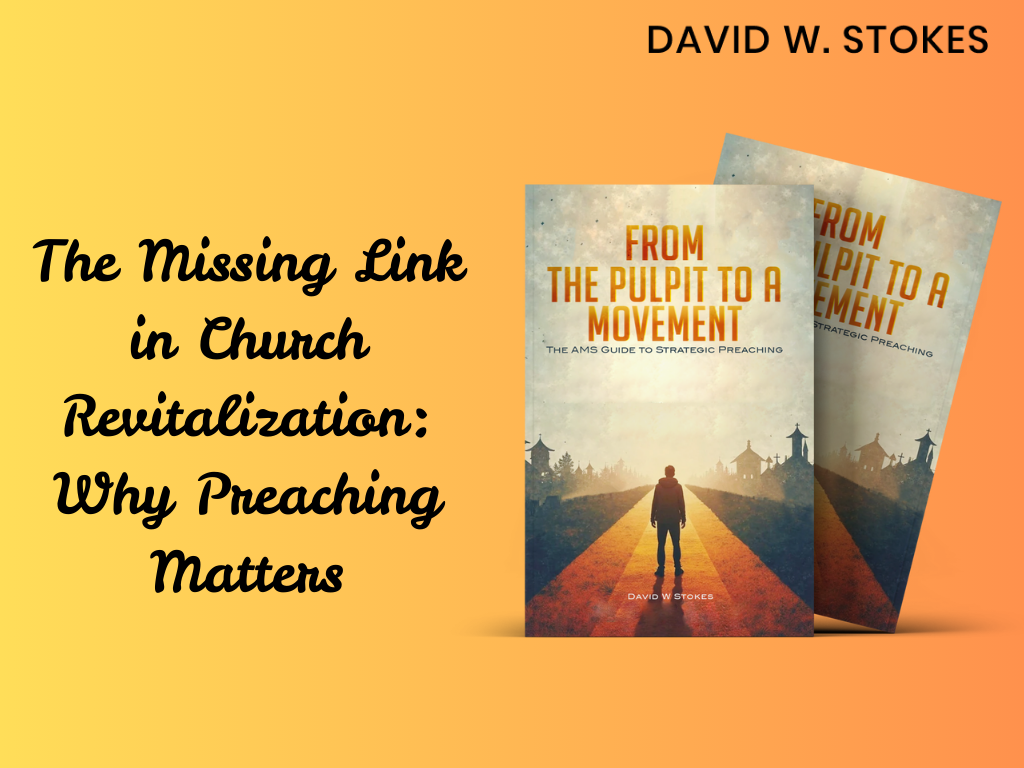
Resurrection of churches has emerged as one of the most burning issues today in the contemporary ministry. Congresses are everywhere, grappling with dwindling attendance, grey membership, loss of mission focus, and fragmentation caused by a change in culture. There has been an endless number of conferences, programs, consultations, and leadership strategies that have promised solutions to help people, yet many churches remain stagnant or even in decline. David W. Stokes, in his influential book From the Pulpit to a Movement, explains it in a very straightforward manner: most of the revitalization efforts ignore the very instrument that made the church what it was initially, preaching. Not only preaching, but preaching that is strategically planned, and guided by the Spirit, and brings individuals to the mission of God and guides them, step-by-step, to renewal.
Stokes suggests that preaching is the silent connection in the revitalization process due to the fact that most leaders are no longer viewing the pulpit as a leadership position. Sermons are inspirational events as opposed to directional ones. Behind the scenes, pastors are planning programs, reorganizing ministries, and creating committees, when the most needed leadership time of the week is being wasted. According to Stokes, revitalization cannot start in a boardroom unless it starts first in the pulpit.
The pulpit, according to him, is where a congregation gets the best feeling of identity, purpose, and direction. On Sunday mornings, people will not listen like in any other meeting or ministry gathering. When a pastor believes in vision and purpose in preaching, the whole congregation is molded, confronted, ordered, and oriented simultaneously. This is power, which is regularly and intelligently employed, and sermons become momentum. But that power has been lost in most of the churches. Preaching has become a weekly preparation on the part of the pastors, instead of a key point of direction in regard to where the church is bound.
The gap Stokes portrays is that churches seek to revitalize themselves in structure, programs, or personalities, but they do not put the heart and mind of the congregation together through preaching. Structural changes can never be permanent without alignment.
Trends in strategic preaching do not exist. It is neither a communication method nor a leadership buzzword. According to Stokes, it is the conscious effort of giving sermons which drives a congregation to a single, biblically focused course. Whereas traditional preaching is frequently concerned with moment-to-moment motivation, strategic preaching is concerned with long-term change, not just of minds and hearts but of actions, systems and culture. It is preaching which elevates the congregation where they are and whither God is calling them.
But why does every church now more than ever need strategic preaching? Stokes is a good portrayal of pain. Churches throughout the country are transitioning; some of them are healing after a loss, others are undergoing changes in leadership, and most are experiencing a change of generations. Pastors are stretched thin. Congregations are weary. Vision is often unclear. All this is in the presence of the fact that churches do not just need good sermons, but ones that provide a lead. Strategic preaching offers that way. It puts the people back into purpose and aligns ministries that seem to be scattered or stagnant.
That is one of the reasons why strategic preaching is so effective because it does not just inspire the congregation on a weekly basis but is a blueprint on how the congregation can become healthy. Stokes divides the issue of how pastors can create preaching calendars and sermon series that lead to renewal.
Instead of thinking of each message as its own stand-alone moment, he invites leaders to think about planning in a purposeful way, creating an arc of biblical truth that eventually forms attitudes, explains mission, and enhances cohesion. Every sermon is a step of the way, and the church starts moving the same way with confidence and understanding.
There are numerous leaders in the Bible who used strategic preaching before this concept was even identified by name. Moses deployed the messages of God to align Israel with the exodus. Nehemiah employed visionary communication as a means of gathering people to restore a failing city. The movements of the sermons and letters of Paul were aimed at the establishment and fortification of churches. And even Jesus Himself preached to change the thinking, to form identity, and to establish the conditions of the Kingdom. Stokes holds that when these leaders were preaching strategically, the current pastors should do the same.